Starting Bedtime Stories From Birth: What Works at Each Stage
Reading a story to a three-month-old looks absurd. They cannot follow a plot, cannot see the page clearly at first, and will not remember any of it. It is also recommended by essentially every paediatric body that has published guidance on early literacy, and the reasons are specific.
Babies: the sound, not the story
What a baby gets from being read to is not narrative. It is the prosody of language — the rhythm, pitch contours and stress patterns that carry meaning before words do. Infants are sensitive to these from birth and use them to segment the speech stream into words, which is the first problem any language learner has to solve.
Practically: the book barely matters, the voice does. Read anything with a pleasant rhythm, hold them close, and let them see your face. Books with strong repetition and high-contrast images suit them best, and a very short session is plenty.
Guidance on choosing material and pacing at this stage is set out in this piece on bedtime stories for babies.
Toddlers: participation and repetition
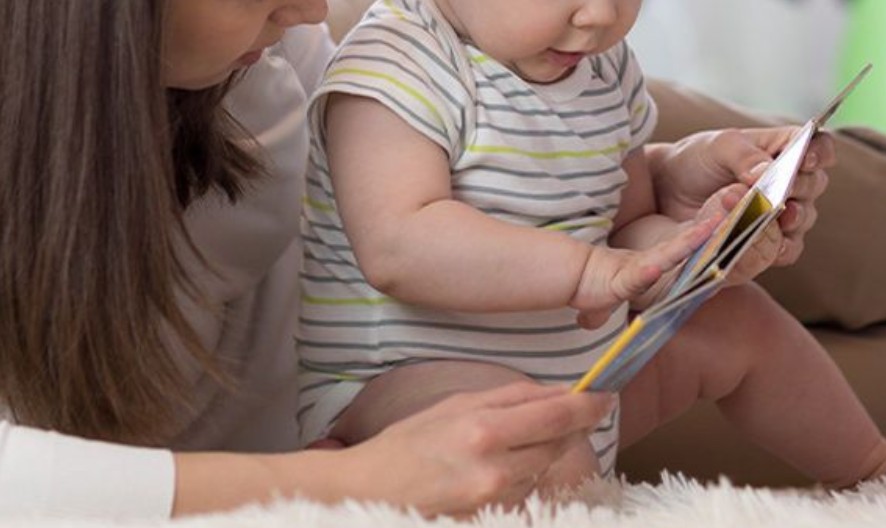
Somewhere around a year, listening becomes doing. Toddlers want to turn pages, point at things, name what they see, and interrupt constantly. This is the correct behaviour and it is the stage where reading aloud starts producing measurable vocabulary gains.
Three things define the stage:
- Repetition. The same book for weeks. This is consolidation, not stubbornness.
- Interruption. The child’s questions are the valuable part; the plot is the excuse.
- Physical handling. They want to hold the book, which means board books survive and paper does not.
Material at this stage needs short sentences, strong rhythm and a predictable structure — collections of bedtime stories for toddlers are pitched to that combination rather than to plot.
Preschool: the plot arrives
Between three and five, children begin genuinely following a story: holding characters in mind, anticipating, and objecting when a familiar story is told wrong. Sessions lengthen, questions get better, and the first stories they can sit through without pictures become possible.
This is also the stage where stories start doing emotional work — a character who is afraid and manages anyway is useful to a child who is afraid of something.
What changes across the stages
| Stage | Session length | What they take from it |
|---|---|---|
| 0–12 months | 2–5 min | Prosody, voice, closeness |
| 1–2 years | 5–10 min | Vocabulary, page-turning, naming |
| 2–3 years | 10 min | Repetition, sequence, joining in |
| 3–5 years | 10–15 min | Plot, prediction, emotional content |
| 5–8 years | 15–20 min | Longer narrative, chapters, discussion |
The habit is the real deliverable
The argument for starting at birth is not that the newborn benefits enormously from the specific words. It is that by the time the child is two and has opinions about everything, the routine already exists and does not have to be introduced against resistance.
Routines established before a child can object are much sturdier than routines introduced afterwards. That is the practical case for starting early, and it is more persuasive than any of the developmental ones.
Where to begin if you are starting now
It does not matter when you start — there is no age at which the benefit disappears, and children who begin at four catch up quickly. Begin with the age you have rather than the age you missed, keep it short, and keep it daily.
For a complete overview of the practice at every age, including the research behind it, this complete guide to bedtime stories covers the ground in one place.
Author